18th Floor, Northpoint Block B,
Mid-Valley City, No. 1, Medan Syed Putra,
59200 Kuala Lumpur, Malaysia







- This event has passed.
Project Seaview: The Great Seawall of Japan by Chai Ming Yang
Start Date: 9/7/2026 - End Date: 26/7/2026 :::
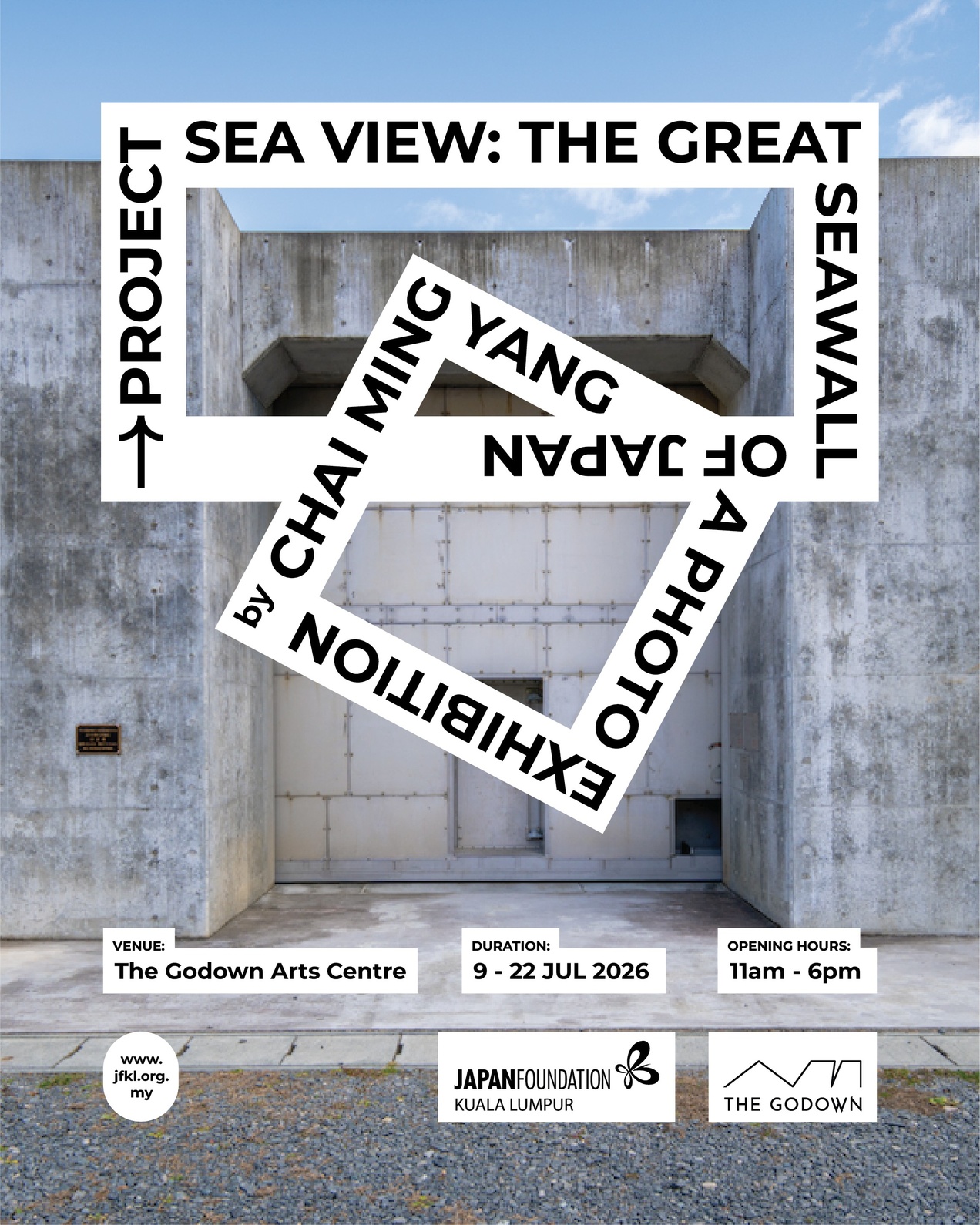
As commemoration for the 15th Anniversary of The Great East Japan Earthquake marked on 11 March of this year, 2026, The Japan Foundation, Kuala Lumpur (JFKL) is organising a photo exhibition featuring stunning images of the nearly 400km seawall erected as a coastal defense across the Tohoku region, captured by photographer, Chai Ming Yang.
Project Seaview: The Great Seawall of Japan
(A Photo Exhibition by Chai Ming Yang)
Exhibition Period:
9 – 22 July 2026
[EXTENDED UNTIL 26 JULY 2026!]
Venue:
The Godown Arts Centre
Opening Hours: 11AM – 6PM
Admission: Free Entry
ARTIST STATEMENT
I began Project Seaview inspired by the resilience of the Japanese people. During my travels along Japan’s coastline, I was struck by the constant reminders of natural disasters— signboards warning of tsunamis, earthquakes, and landslides appeared everywhere. Yet despite these ever-present risks, millions of people continue to live, work, and raise their families in these communities. I deeply admire their courage and determination.
This curiosity led me to explore how Japan responded to one of the worst natural disasters in its history: the 2011 Tōhoku earthquake and tsunami. I wanted to understand whether people had returned to rebuild the devastated towns and cities, and how these communities were recovering. In the process, I discovered the Great Seawall Project—an ambitious effort designed to protect lives from future tsunamis, but one that has also dramatically transformed the relationship between people and the sea.
With my architecture background, I was fascinated by the scale of this undertaking. Stretching for hundreds of kilometres along the northeastern coast, it is one of the largest coastal engineering projects ever built. Through Project Seaview, I set out to document these colossal structures and explore what it feels like to stand behind these massive concrete walls, where protection, memory, and the landscape converge.
Check out the webpage for the project:
www.mingyangchai.com/projects/project-sea-view
THE GREAT EAST JAPAN EARTHQUAKE
On 11 March 2011, a magnitude 9.0 undersea megathrust earthquake that struck Tohoku region, northeastern part of Japan.
This earthquake caused a tsunami on the Pacific coast from Hokkaido, Tohoku, and Kanto regions, such as Soma-city with tsunami heights over 7.3 meters, of 4.2 meters in Oarai-city, and over 4.1 meters in Kamaishi-city, the run-up height in some cities in Tohoku area even went up to 40 meters, devastated hundreds of kilometres ofcoastline. The number of deceased due to this earthquake and tsunami reached nearly 20,000.
To protect the lives of citizens, buildings and crops from future tsunamis, a total length of approx. 400 kilometres of new or upgraded seawalls were constructed along parts of the Tohoku coast. Some seawalls reach heights of 10-15meters (33-50 feet)
Last Updated: 1 July 2026

Office – Monday to Friday, 8:30 AM to 4:30 PM
(Closed on Saturday, Sunday and Public Holidays)
Library – Tuesday to Saturday, 10:00 AM to 5:30 PM
(Closed on Sunday, Monday and Public Holidays)
FOLLOW US: